If you've heard of or practised breathwork’s “humming breath”, I urge you to read on. Because what’s trending online is often a stripped-down version of something much deeper. 🐝 The humming breath is an incomplete appropriation of a yogic practice called Bhramari Pranayama. 1) Inhale, Hum Out? Bhramari Pranayama is not just inhaling and humming out. It's …

If you’ve heard of or practised breathwork’s “humming breath”, I urge you to read on. Because what’s trending online is often a stripped-down version of something much deeper. 🐝
The humming breath is an incomplete appropriation of a yogic practice called Bhramari Pranayama.
1) Inhale, Hum Out?
Bhramari Pranayama is not just inhaling and humming out. It’s a continuous vibration – from humming out (the male bee) to humming in (the female bee). This sustained vibration is one of the reasons the practice is so effective for tension and headaches. The gentle internal pressure and resonance can soothe the nervous system profoundly. (Caveat: if you have hypertension you should avoid humming in or practise only under guidance).
2) Tongue Position
Tongue position matters: You can simply relax the tongue in the mouth during Bhramari Pranayama. But yogic science also recognises that different tongue positions can enhance energetic and neurological effects. Just as in Sanskrit – where tongue placement is precise and meaningful – positioning inside the mouth is not arbitrary. There are subtle mechanics at play.
3) Your Helping Hand
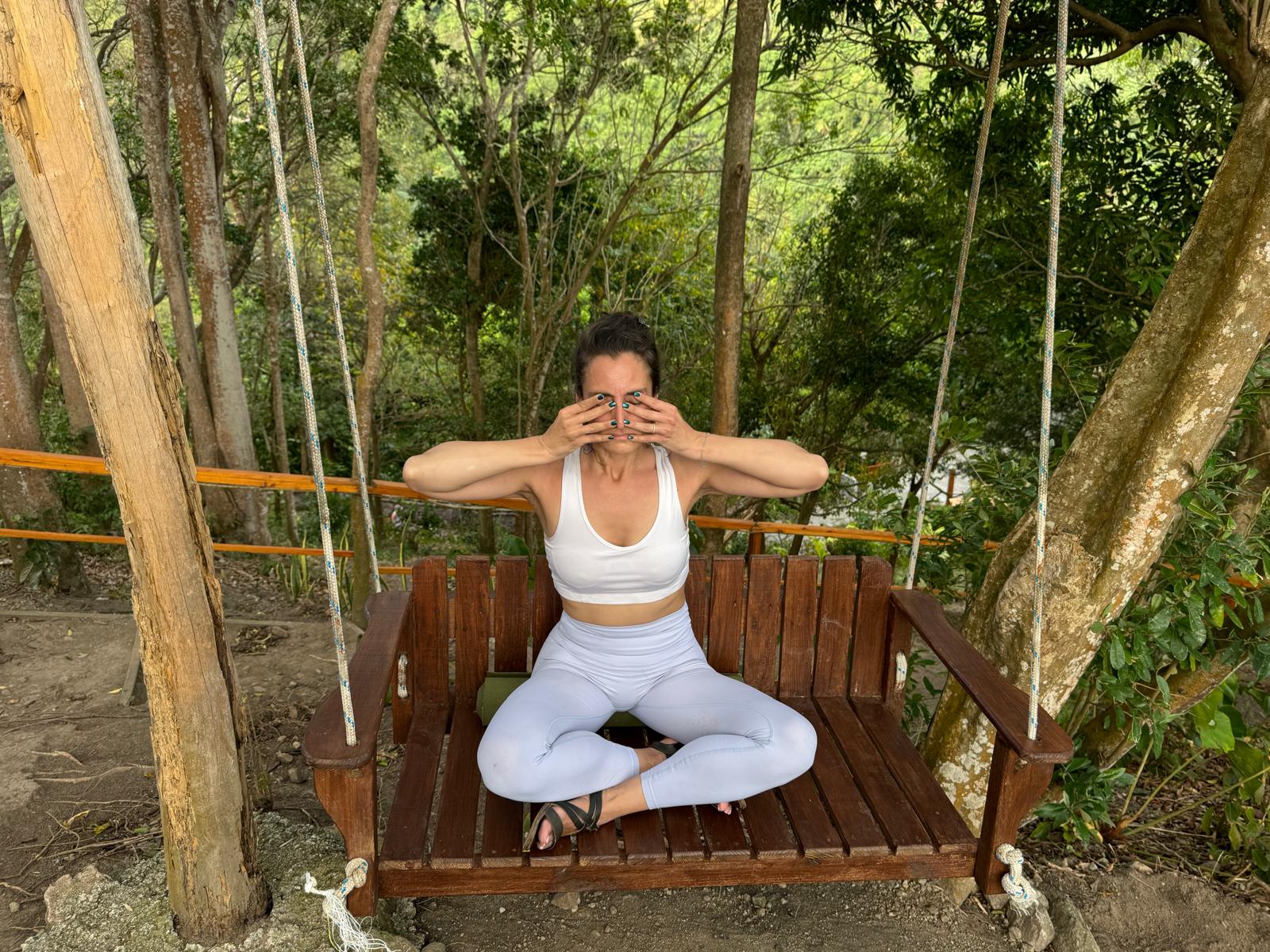
Your hands are supporting the breathing practice: Shanmukhi Mudra, a positioning of the hands over eyes, nose, mouth and ears helps to withdraw the senses. This internalisation makes Bhramari far more powerful than a simple humming technique. By pressing onto the tragus of the ear, as done in this mudra, you stimulate branches of the vagus nerve. Science can now confirm this vagal stimulation through pressure on the tragus. It can also prove the increased production of nitric oxide that humming creates. These measurable effects help explain why the practice regulates the nervous system so effectively.
Ancient Wisdom & Modern Science
But just because modern research can measure vagal tone and nitric oxide does not mean we have reached the full understanding of what is happening in this practice. Science is young. It is evolving. It does not have all the answers yet. If we want all the answers, we must look to more ancient practices as well. In a few decades, science may well have caught up with wisdom that has been preserved for millennia.
Modern breathwork is not wrong. It’s just not good enough. When Pranayama is reduced to technique alone and stripped of essential aspects, something important is lost.
Get in Touch with Us
We’d love to hear from you—share your thoughts or ask a question!